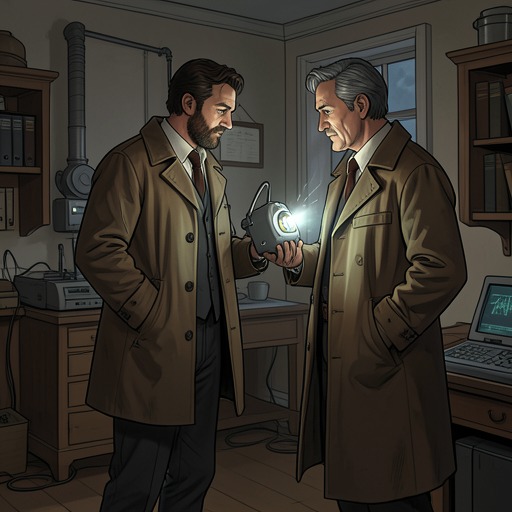
Peter Gabanis
The TommyknockersPeter Gabbons, called Jingles by his fellow officers, is a state trooper whose patrol with Benton Rhodes becomes an early, bodily encounter with Haven’s spreading horror. His gravelly voice and familiar nickname belong to ordinary police life; his sudden sickness, fear, and later place in the town’s shared mental network show how that ordinary life is being overtaken. The evidence does not establish his ultimate fate, but it places him among the residents whose minds have become connected as Haven changes.
Identity and Introduction
Gabbons is riding shotgun with Trooper Benton Rhodes on the evening of July 24, a week after David Brown’s disappearance. They are driving a state police cruiser out of Haven at about eight o’clock. Rhodes is distracted by the severed hand and arm he has encountered and by the certainty that he recognized their former owner. Even as he tries to force the memory aside, it keeps returning; the patrol begins under the pressure of a horror that has already entered the officers’ thoughts.
The name Jingles comes from Gabbons’s gravelly voice, compared in the narrative to that of Andy Devine, who played a character called Jingles in an old television western. When Gabbons came north from Georgia, dispatcher Tug Ellender began using the nickname, and it stuck. The familiar name and voice give him a recognizable place in the department’s everyday social world, making his later high, strangled speech a striking break from the persona his colleagues know.
The Patrol with Rhodes
During the drive, Rhodes asks Gabbons to try the radio again, suspecting interference from a microwave dish in Troy. When Gabbons abruptly tells him to pull over because he is sick, Rhodes brakes so sharply that the cruiser nearly skids into a ditch. Both men get out on opposite sides of the car and vomit beside the road, under the blue strobe of the cruiser’s lights. The scene makes their reaction physical and shared: neither officer can keep composure in the face of what they have encountered.
Gabbons is the first to call out that something is wrong. Later, when Rhodes asks whether he felt anything strange, Gabbons answers cautiously that perhaps he did. His tentative response matters because he does not present himself as understanding the experience; he can only acknowledge a sensation that Rhodes has also noticed. The patrol’s unease continues when they encounter a pickup truck slewed diagonally across the road. Rhodes brakes with the cruiser’s nose stopping three yards from it, while Gabbons trembles and jokes bleakly about needing toilet paper. When a shrill, crazed titter comes from the truck bed and fades, Gabbons moans that he does not like the situation. Rhodes advances with his gun raised, and green light suddenly fills the world.
Gabbons’s responses move from nausea to guarded recognition, then fear. He does not solve the mystery of the roadside events, but his reactions register their force before the danger becomes comprehensible. His familiar voice turns strangled; his attempt at gallows humor cannot dispel the dread. The police cruiser, radio, and routine patrol remain present, yet the ordinary tools and habits of the job offer no assurance of control.
A Town Connected by Mind
The wider changes in Haven give Gabbons’s brief uncertainty a larger context. Ruth McCausland realizes that, for a week or more, she and other residents have been knowing things without having to learn them in the ordinary way. The knowledge seems as natural as a heartbeat, even as she recognizes that it is changing Haven for the worse. The town’s new mental connection is therefore not simply a useful capacity: it is an intimate alteration that residents may barely notice while it reshapes their shared life.
When the residents prepare to search for David Brown, their minds join instinctively as soon as Ruth arrives. They search for David together and know, before the search begins, that they will not find him. Their combined mental call would have caused David pain within seventy miles and reached him at five times that distance, yet he is not merely missing: he is “not-there.” This collective search demonstrates the network’s reach while also exposing its limits. The town can join minds and direct its attention with overwhelming force, but that power cannot locate David.
The search also shows that connection does not automatically create solidarity. In the heat and darkness, people stumble through thickets and deadfalls, and fistfights break out before midnight. Ruth keeps the search moving, even as she is exhausted by the effort to find David and resist the changes in her own mind. The shared mental life that could coordinate Haven has not produced peace; its inhabitants remain capable of conflict even while linked.
Participation in Haven’s Collective Life
After the explosion, Haven’s residents act as a network of silent voices without needing to assemble in the same place. Beach Jernigan continues frying hamburgers at the Haven Lunch; Nancy Voss sorts stamps at the post office; Bobby Tremain works beneath his car on a backflow rebreather; and Newt Berringer drives toward Henry Applegate’s workshop. Their separate activities do not prevent them from being mentally together. Less than forty-five minutes after the explosion, about seventy people have gathered at Applegate’s, a rapid response enabled by this connection.
The contrast is central to Gabbons’s place in the story. On patrol, he and Rhodes encounter the consequences of Haven’s disturbance as isolated officers on a road, forced to respond through radio calls, reflexes, and physical courage. In the altered town, residents can share awareness across distance and assemble with remarkable speed. But the same connected community is not a single, uniformly benevolent will: the search for David is marked by violence, and collective knowledge accompanies changes Ruth fears.
Later, when Bobbi’s screams blanket Haven like an air-raid siren, the changed residents stop what they are doing and drift into the village streets. Their first shared response is dismay, pain, and horror, followed by anger; they know who caused the screams, and no other mental voice can be heard while the agony continues. This scene extends the pattern already glimpsed in Gabbons’s patrol: mental connection makes a distant or individual disturbance communal, but it can also concentrate attention and emotion until the rest of the town falls silent.
Narrative Role
Gabbons is introduced not as an investigator who can explain Haven but as a working trooper caught inside events that exceed the routines of his profession. His nickname and gravelly voice establish the familiar social character of the partner beside Rhodes; the strangled request to pull over, the shared vomiting, and his trembling reaction to the truck make the crisis legible through bodily response rather than exposition. The sequence moves from an apparently practical concern about radio interference to a roadside encounter that ends in overwhelming green light, turning an ordinary patrol into a threshold of danger.
His later significance is collective rather than solitary. The evidence places him among the people affected by Haven’s shared mental life and illustrates how that life can bind residents into action without eliminating fear, disagreement, or harm. Gabbons’s appearance thus helps frame the town’s transformation as both an inward alteration and a social condition: its inhabitants become connected, but connection does not mean that they understand what is happening or can protect one another from it.